
The best time to see the wildebeest migration in the Masai Mara is July through October, when an estimated 1.5+ million wildebeest, plus hundreds of thousands of zebra and gazelle, move north from Tanzania’s Serengeti into Kenya. August and September are the peak months for witnessing dramatic Mara River crossings. Because the herds follow the rains, exact dates shift by a few weeks each year, but the migration is reliably in the Mara during the dry season from mid-July to late October.
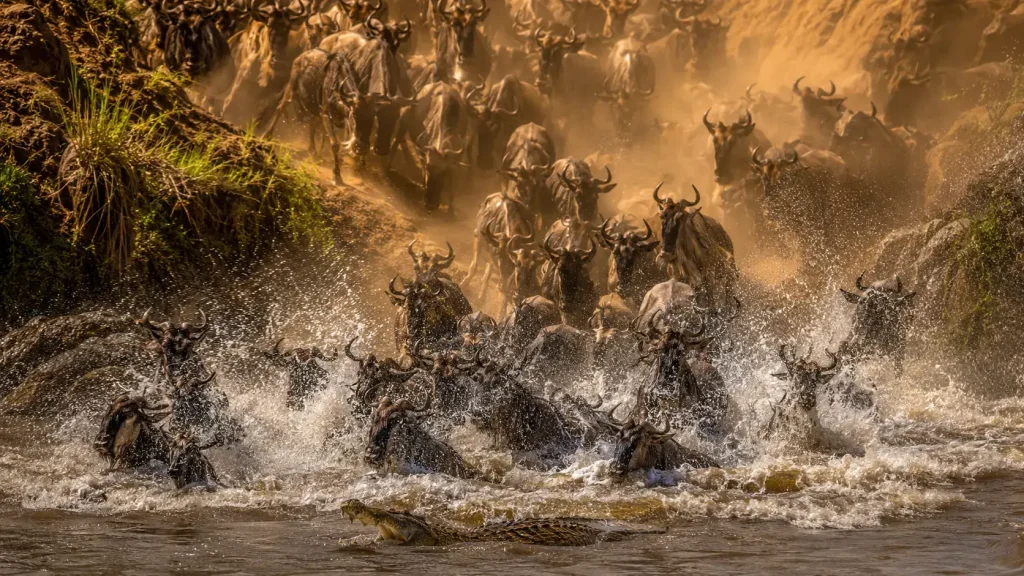
Few sights on Earth rival the moment a thundering column of wildebeest plunges down a riverbank and into the crocodile-filled Mara River. This is the climax of the Great Migration, and the Masai Mara National Reserve in southwest Kenya is the best place on the planet to witness it up close.
But here is the catch that trips up most travellers: the wildebeest are not in the Mara all year. For roughly eight months they are in Tanzania. Book the wrong month and you may arrive to find quiet plains and resident game, but none of the spectacle you flew across the world to see. This guide breaks down exactly what is happening in the Masai Mara every month, so you can plan a trip around the experience you want most.
Table of Contents
What is the Great Wildebeest Migration?
The Great Wildebeest Migration is the year-round, circular movement of around 1.5 million wildebeest, alongside roughly 200,000 zebra and 300,000 gazelle, through the Serengeti; Mara ecosystem that straddles Tanzania and Kenya. The herds travel a clockwise loop of about 800 kilometres each year, driven by rainfall and the search for fresh grazing.
It is not a single event but a continuous cycle. The same herds calve in the southern Serengeti early in the year, march north and west through the dry season, cross into the Masai Mara around July, and return south as the short rains arrive in November. The Masai Mara is the northern tip of this loop, which is why the herds are only present here for part of the year.
When Is the Best Time to See the Migration in the Masai Mara?
Visit between late July and October for the migration, and target August to September if river crossings are your priority. July is excellent for the herds; dramatic arrival, while October offers crossings with thinner crowds before the herds drift back to Tanzania.
If your goal is simply to see the vast herds blanketing the plains, any time from late July through October delivers. If you specifically want to witness a river crossing, the unpredictable but unforgettable highlight of the migration, August and September give you the best odds.
Wildebeest Migration in the Masai Mara: Month by Month
Here is where the herds are throughout the year and what each month means for a Masai Mara safari. Remember: the migration follows the rains, so timing can shift by two to four weeks in any given year.
January
Where the herds are: Southern Serengeti, Tanzania (not in the Mara)
Calving season is approaching in the southern Serengeti and Ndutu plains. The Masai Mara is quiet, green and excellent for resident wildlife, big cats, elephants and birdlife, but the migrating herds are hundreds of kilometres south.
February
Where the herds are: Southern Serengeti, Tanzania (not in the Mara)
Peak calving: around 8,000 wildebeest are born per day in the southern Serengeti. This is a superb time for predator action, but in Tanzania, not Kenya. The Mara remains a good destination for residents and lower-season rates.
March
Where the herds are: Southern Serengeti, Tanzania (not in the Mara)
The herds begin to stir and gather as the short-grass plains dry out. Still firmly in Tanzania. In the Mara, expect green landscapes and the start of the low season as long rains approach.
April
Where the herds are: Central Serengeti, Tanzania (not in the Mara)
The long rains arrive. Herds move north and west through the central Serengeti. The Masai Mara is at its greenest and quietest, with the fewest crowds and lowest prices, ideal for budget-conscious travellers focused on resident game and birding.
May
Where the herds are: Western / central Serengeti, Tanzania (not in the Mara)
Rutting (mating) season begins as columns of wildebeest push toward the Western Corridor and Grumeti River. The herds are still in Tanzania. The Mara stays green and quiet.
June
Where the herds are: Western & northern Serengeti, Tanzania (front-runners nearing the border)
The dry season begins. Grumeti River crossings occur in Tanzania, and the leading herds press toward the Kenyan border. In a year with early rains, the first wildebeest can reach the Masai Mara in late June, but this is the exception, not the rule.
July
Where the herds are: Arriving in the Masai Mara
The migration crosses into Kenya. Herds spill into the Mara and the first Mara River crossings begin, typically in the second half of the month. An outstanding time to visit, with the energy of the arrival and fewer crowds than peak August.
August
Where the herds are: Masai Mara (peak)
Peak migration. Enormous herds blanket the plains and Mara River crossings are at their most frequent and dramatic. This is the single best month for crossings, and also the busiest and most expensive, so book lodges well in advance.
September
Where the herds are: Masai Mara (peak)
Crossings continue and the herds are spread widely across the reserve. Many guides consider September the sweet spot: excellent crossing odds with slightly thinner crowds and marginally better value than August.
October
Where the herds are: Masai Mara, beginning to move south
The herds are still present and late crossings are common, but they begin drifting back toward Tanzania as the month ends. A smart choice for travellers who want crossings with noticeably fewer vehicles and softer prices.
November
Where the herds are: Returning to the Serengeti, Tanzania
The short rains begin and the herds move south out of the Mara back into Tanzania. The migration spectacle largely ends in Kenya. The Mara returns to excellent resident-game viewing in green, uncrowded conditions.
December
Where the herds are: Southern Serengeti, Tanzania (not in the Mara)
The herds settle back onto the southern Serengeti’s short-grass plains ahead of calving. The Masai Mara offers lush scenery, resident predators and a peaceful festive-season safari, but no migrating herds.
Best Months Ranked: Crossings, Crowds & Cost
At a glance, here is how the prime migration months in the Masai Mara compare:
| Month | River Crossings | Crowds | Price | Best For |
|---|---|---|---|---|
| August | Highest | Very high | Peak | First-timers who want the best crossing odds |
| September | Excellent | High | High | The all-round sweet spot: crossings + value |
| July | Beginning | Moderate | High | The dramatic arrival, fewer crowds than Aug |
| October | Good (late) | Moderate | Mid-high | Crossings with thinner crowds, softer rates |
| Apr–May | None | Lowest | Lowest | Green season, residents, birding, budget trips |
Understanding the Mara River Crossings
The Mara River crossing is the most sought-after moment of any migration safari, and the least predictable. Herds gather on the riverbank, sometimes for hours, before a single wildebeest triggers a chaotic stampede across crocodile-infested waters. Here is what every traveller should know.
Crossings cannot be scheduled
No guide, lodge or operator can guarantee a crossing on a specific day. The herds move on instinct and weather. Even in peak season, you may wait a day or two, or get lucky within hours. The single best way to improve your odds is to allow time: plan at least three to four nights in the Mara during August or September rather than a rushed one-night stop.
Where crossings happen
Crossings occur along the Mara River and the smaller Talek River, with hotspots in the reserves; northern and western sections and in the adjoining conservancies. Staying near the river dramatically reduces your morning drive time to the crossing points, which matters when timing is everything.
Conservancies vs. the main reserve
The private conservancies bordering the Masai Mara (such as Mara North, Olare Motorogi and Naboisho) host the same migrating herds with far fewer vehicles, off-road access and night drives. They cost more per night but deliver a more exclusive crossing experience. The main reserve offers the classic Mara River crossing sites and is more budget-friendly. [Internal link: see our Masai Mara conservancy guide].
How to Plan Your Migration Safari
- Book early. The best riverside camps for August and September sell out 6&12 months ahead. Secure lodging before flights.
- Stay 3+ nights. Crossings are unpredictable; more nights means dramatically better odds of witnessing one.
- Choose your location wisely. Riverside camps and northern conservancies put you closest to the action.
- Consider the shoulder. Late September and October offer crossings with fewer crowds and better rates than peak August.
- Pack for cool mornings. July&October is the dry season; game-drive mornings are chilly, afternoons warm and dusty. Layers and neutral colours are ideal.
Frequently Asked Questions
What is the best month to see the wildebeest migration in the Masai Mara?
August is the best single month for Mara River crossings, with September a very close second offering slightly fewer crowds. The broader migration window in the Masai Mara runs from late July to October.
Can you see the wildebeest migration in the Masai Mara all year round?
No. The migrating herds are only in the Masai Mara for part of the year, roughly July to October. For the rest of the year they are in Tanzania’s Serengeti. Outside these months the Mara still offers excellent resident wildlife, including the Big Five, but not the migration spectacle.
When do the Mara River crossings happen?
Mara River crossings typically occur between late July and October, peaking in August and September. They cannot be predicted to a specific date, so allowing several nights in the reserve greatly improves your chances of seeing one.
Is the wildebeest migration in Kenya or Tanzania?
Both. The migration is a continuous loop through the Serengeti-Mara ecosystem. The herds spend most of the year in Tanzania’s Serengeti and cross into Kenya’s Masai Mara around July through October, which is when the famous Mara River crossings take place.
How many days do I need in the Masai Mara to see a crossing?
Plan for at least three to four nights during peak season. Crossings are unpredictable, so the more time you spend near the river, the better your odds of witnessing one.
What is the cheapest time to visit the Masai Mara?
April and May, during the long rains, are the lowest season with the best rates and fewest crowds. The migrating herds are not present then, but resident wildlife viewing and birding are excellent.